

Contact Us

Fire & Emergency Services - Social Media




Fire & Emergency Services - FaceBook
Fire & Emergency Services - Twitter
The Fire Prevention Division is dedicated to the protection of life and property. Personnel are assigned to one of four sections; Community Programs, Fire Safety Inspections, Fire Investigations and Hazardous Materials. They are guided by three principles - Education - Engineering - Enforcement.
Education is the primary focus of day to day activities. A better informed individual will understand the importance of creating a safer environment and overall make good decisions in an emergency. Through this proactive effort, we hope to lessen the number of incidents or at the very least, the severity. It certainly transcends all four sections of the Division.
Engineering is important to understanding the appropriate design, application and construction of building components. It is utilized through the development and application of local, state and national codes, standards and ordinances. Sound industry principles, past experiences and laboratory tests are the basis for these documents. Understanding the science of fire is a key factor for staff to effectively carry out their responsibilities. As such, education for our staff and the public is the key to proper application and compliance.
Enforcement, though a last resort, is an avenue to ensure the building environment and associated activities meet an acceptable fire safe standard. It is hoped that through education, we will be able to obtain voluntary compliance.
Collectively, these principles allow us to move one step closer to our goal of improving fire and life safety for our community. Please join our efforts by being safety conscious. Enlist the help of your family and co-workers to keep everyone "safety aware". Educate and plan what you can do to prevent or control a life threatening situation. Throughout this website are tips which we hope will assist you in this effort. Please do not hesitate to call us for assistance. Together we can make Richmond a safer community.
Some of our divisional activities include:
- Fifth grade fire safety program
- Holiday and special occasion safety presentations
- Courtesy home fire safety surveys
- Fire Prevention Week activities
- Fire Safety House
- Fire code inspections in commercial businesses
- High rise fire safety inspections
- Fire protection system maintenance compliance
- Tank removal inspections
- Blasting inspections and permitting
- Pyrotechnics inspections and permitting
- Fumigation inspections and permitting
- Night and weekend life safety inspections
- Compliance regarding fire and life safety hazards
- Special events inspections and standbys
- Hazardous material contingency planning
- Coordinating hazardous materials Tier II reporting
- Local Emergency Planning Committee (LEPC)
- Fire investigation services
- Freedom of Information Act request
- Site and construction plan review/consultation/field inspections
- Stove Top Fire Stop
- Rest Safe in RVA
- Quality customer service
Open Burning
- Open burning is permitted only with approval from the Fire Code Official and must meet all conditions specified for silvicultural, recreational, religious, ceremonial, trench, and bonfire activities.
-
Open burning that is offensive or objectionable due to smoke emissions, or that becomes hazardous because of atmospheric conditions or local circumstances, is strictly prohibited.
-
The use of burn barrels is not prohibited; however, they must comply with the same guidelines that apply to fire pits.
-
Burning on any property without ownership or written permission from the property owner is always prohibited.
-
The Fire Department has the authority to extinguish any fire—permitted or not—that creates or contributes to a hazardous or objectionable situation. Repeated calls for service to the same location may result in the fire being extinguished.
-
To determine if a permit is required, please contact the Fire Marshal’s Office at (804) 646-6640.
Portable Outdoor Fire Devices
-
Stoves, incinerators, and other controlled-burning devices—including patio fireplaces—are not classified as open burning and therefore do not require an open burning permit.
-
Pre-manufactured fireplace devices must be placed at least 15 feet away from any structure or combustible material. As with recreational fires, you must have an approved means of extinguishment readily available.
-
As with any heat-producing device, patio fireplaces should be used with caution, keeping them safely distanced from buildings and combustible materials, and maintaining constant supervision while in use.
-
The Richmond Fire Department recommends using these devices strictly in accordance with all manufacturer instructions and safety guidelines.
-
Usage of these devices on any property without ownership or written permission from the property owner is always prohibited.
Code Enforcement Responsibilities
- Inspections and Site Visits
- Investigation of Complaints
- Issuance of Violation Notices
- Issuance of Summons
- Verification of Compliance & Corrective Actions
- Issuance of Permits
Through consultation, site visits, and code inspections, division personnel administer and enforce laws related to fire safety, including the Virginia Statewide Fire Prevention Code, the Code of Virginia and the Code of Richmond. Inspections are scheduled, as well as conducted as "walk-ins." Inspections may also occur based on a complaint or concern voiced by the public or another City agency. Our inspectors also perform required license inspections of state regulated care facilities, which include child care and adult care centers. Evening inspections are also conducted on a routine basis. The purpose of our Night Duty inspections is to ensure that restaurants, nightclubs and other gathering places are adhering to the law as it applies to occupancy limits. While the vast majority of these businesses comply with the code, there are a few who are less diligent. Locked or blocked exit doors, inadequate signage or lighting, and overcrowding all place the public at risk. The Fire Marshal's Office will cite owners/operators for such violations, as well as take immediate action to have them corrected.
If code violations are noted, a Notice of Violation (N.O.V.) is issued. The N.O.V. explains what violations were found and the date they are to be corrected. A re-inspection is then conducted to verify that the violations have been corrected. If the violations have not been corrected, another N.O.V. is issued or a summons to General District Court may be served. Generally, summons are used in cases where the inspector finds insufficient effort to comply with the law. However, a summons may be issued upon discovery of extreme, blatant, or repeat violations. Violations are Class 1 misdemeanors, and carry a penalty of up to $2,500 and up to 1 year in jail per violation.
The Prevention Division issues permits for a number of businesses and activities. Where applicable, a permit application will also be made available. To view some of the permits that are issued by this office.
Other services provided by the Prevention Division include reviews of:
- Building and Site Plans for Fire Code Compliance
- Special-Use Permits
- Inspection/Test Reports for Fire Protection Systems (Detection/Alarm, Sprinkler, Kitchen Hood, Special Hazard, etc.) Corrective action and follow-up is mandated for any noted deficiencies.
Requirements for Code Enforcement Personnel
To become certified a candidate will need: 80 hours classroom, and 20 hours performance skills from the Virginia Fire Marshal Academy; 24 hours classroom training from the Commonwealth of Virginia, Department of Housing and Community Development.
To maintain certification a candidate will need: 16 hours every two years from a designated course curriculum approved by the Virginia Fire Marshal Academy.
Investigates fires per Virginia code:
- Fire Fatality
- Fire Injury
- Multi-Alarm
- Large Dollar Loss
- Arson Bomb Threats Post-Bomb Investigation
- Threat to Burn Investigation
- Juvenile Involvement
- Case Documentation
- Maintains Official Records
- Responds to Request for Record (FOIA/Subpoena)
- Initiates Arrests for Fire-Related Crimes
- Assists Commonwealth in Prosecution of Fire-Related Crimes
- Juvenile Firesetter Program
- Identification
- Screening
- Intervention
- Intervention Referral/Recommendation
- Other Emergency Duties as Requested
- Follow-Up
- Accelerant K-9 Program
- Public Awareness Program and Schools, Senior Groups, Civic Association, etc.
Friends In Residential Emergencies
Friends In Residential Emergencies, "F.I.R.E.", is a committee of citizens interested in fire safety; most come from various civic associations throughout the city. They meet quarterly, and you can contact Fire Prevention for details. The mailing address is c/o City Fire Prevention Office, 1904 N Hamilton St, Richmond, Virginia 23230. The phone number is (804)646-0621.
F.I.R.E. is a 501(c)(3) incorporated, non-profit organization which is designed to receive tax deductible donations and channel funds for fire department activities beyond city finance limitations. Its purpose is to assist fire prevention agencies in the Richmond area in promoting fire safety and to do and perform every lawful act necessary or expedient or desirable in connection with and to effectively carry out the purpose of the Corporation.
The mission of F.I.R.E. is to reduce the loss of life and property due to fire through education, demonstration of fire safety methods, and distribution of such materials as available to save lives.
The objectives of F.I.R.E. are:
- To attend public meetings to promote fire safety
- To obtain funding for fire safety-related material to be used in a public education program to promote fire safety
- To eliminate the loss of life due to fire
- To reduce the loss of property due to fire
F.I.R.E. members are helpful in providing the public's perspective of the Fire Department and they are able to reach some of the public which may not be as accessible by departmental staff. F.I.R.E. has an account with the Fire Department Credit Union, through which un-solicited donations for purchase of materials beyond city finances (such as smoke detectors) can be channeled. The phone number for F.I.R.E. is (804)646-0621. The mailing address is F.I.R.E. c/o City Fire Prevention Office,1904 N Hamilton St, Richmond, Virginia 23230.
Residents of the city are encouraged to join F.I.R.E. so there can be a clear avenue for communication. Each community association should be represented to improve fire and life safety throughout the city.
Fire Prevention
Fire Prevention Values
Fifth Grade Fire Safety Education Program
The Fire Safety Education Program (F.S.E.P.) was implemented into the Richmond Public Schools by the Richmond Fire Department in September 1980. Recognizing the increase in fire events and fire deaths on the national, state and local levels, the Fire Marshal realized that very little could be done to reduce national and state statistics, but there was plenty to be done for Richmond.
Information was gathered from Baltimore, New York, Chicago, St. Louis, Oakland, Raleigh, Philadelphia, Jersey City, Washington, D.C. and Los Angeles because the program was already instituted in their schools. The fifth grade was the target group based on a general consensus of all the fire safety educators.
Since 1980, more than 65,000 students in the Richmond Public Schools have received instruction through this program. The implementation of the F.S.E.P has proven to be an invaluable asset for the Richmond Fire Department and Richmond Public Schools in educating, motivating and better informing students on fire and life safety.
The F.S.E.P. consists of the following:
- Written pre-test
- Four classroom presentations
- Two homework assignments
- Written post-test
Each student receives a Fifth Grade Student Resource Manual that includes an overview of the F.S.E.P. program and important material to support the classroom presentations.
Success is not only noted in the grades the students receive but a clear understanding of the life lessons learned. Over the years, numerous graduates of the program have utilized their knowledge to positively impact emergency incidents in our community.
Richmond Emergency Planning Committee
What is the REPC?
The Richmond Emergency Planning Committee (REPC) was formed in accordance with the "Emergency Planning and Community Right-To-Know Act of 1986 "(Superfund Amendments and Reauthorization Act ("SARA"), Title II, 42 U.S.C. Section 11001)." The REPC's purpose is to prepare an emergency plan to minimize the impact upon the community of possible releases of hazardous substances.
The REPC membership is comprised of elected local and state officials, police, fire, civil defense, public health professionals, environmental, hospital, and transportation officials representative of Richmond. Also included in the membership are representatives of facilities, community groups, and the local media.
What does the REPC do?
The primary duties of the REPC:
- Prepare and coordinate a chemical emergency response plan for all facilities in the city where extremely hazardous materials are present in quantities above a threshold planning quantity, as required by SARA Title III, Section 303.
- Collect and maintain SARA Section 312 hazardous chemical inventory reports (Tier II reports) for facilities required to submit such reports.
- Receive information about reportable accidental chemical releases and ensure that emergency response plans are followed by the responsible facility when responding to such releases.
- Assist the City of Richmond in the preparation of a Hazardous Material Emergency Response Preparedness Assessment.
- Ensure the review, implementation and updating of the Richmond Chemical Emergency Response Plan and the component plans for each reporting facility.
- Maintain a database of all planning and reporting facilities and the hazardous chemicals reported by these facilities utilizing the CAMEO chemical information systems database.
- Provide outreach and education to the community and other municipalities concerning hazardous materials.
Meetings
All interested persons are invited and encouraged to attend REPC meetings. For specific meeting locations, dates, times, and directions, please call the Richmond Hazardous Materials Coordinator at (804)646-6660.
Public Access to REPC Files
Upon receiving the Emergency Coordinator's permission, any person may inspect and copy REPC files. All requests to review the files shall be made to the Emergency Coordinator in writing and shall include the requester's name, address, business (optional), telephone number (optional), a brief description of the files or information desired, and the dates and times access is desired. The Emergency Coordinator shall arrange an appointment at a mutually agreeable time.
The public shall not be granted unsupervised access to REPC files. An REPC member or Fire Department employee shall be present whenever a member of the general public is accessing REPC files. The Emergency Coordinator shall make every effort to accommodate requests as expeditiously and as conveniently as possible. However, the Emergency Coordinator must respond to emergencies and other community priorities, and requesters may have to wait or interrupt their visits until the Emergency Coordinator is available.
Any person may request copies of any REPC document or file. Requests for copies shall be made to the Emergency Coordinator in writing and shall include the requester's name, address, business (optional), telephone number (optional), an exact description of the files or information desired, the total number of pages to be copied (this may be supplied by the Emergency Coordinator), the number of copies to make of each original page, and the dates the copies are needed. The Emergency Coordinator shall make every effort to accommodate requests as expeditiously as possible. The Emergency Coordinator may charge the requester an appropriate fee according to current City policy. Fees shall be paid to the City of Richmond, not the REPC.
The Emergency Coordinator may inform industries or facilities when a member of the public requests to see or copy their files. The Emergency Coordinator shall report such requests to the REPC at the next scheduled meeting.
The City of Richmond Tier II reporters are invited to use our new and unique system for reporting the storage of chemicals. The reporting is done online in order to streamline workflow and eliminates the need to send paper copies of the report to the LEPC and Richmond Fire & Emergency Services.
Please direct your browser to the following URL
Arson Fact Sheet
ACCELERANT DETECTION K9
Fire Investigation
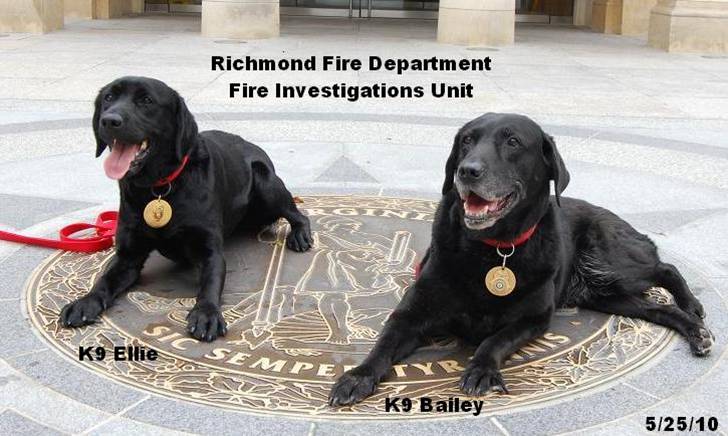
 The Fire Investigation Section as its name implies, investigates the cause of fires. Prevention of future fires through knowledge gained in these investigations is a major goal. The discovery of, arrest and conviction of all arsonists is also a major focus of the units' members. Determining the origin and cause of a fire can also serve the following purposes:
- Gives those involved a piece of mind as to exactly what happened.
- Provides valuable information which can be used in civil litigation.
- Provides data on equipment failures which may lead to the need for a manufacturers recall.
- Provides subject matter or statistical data that can be used in our community safety programs.
- Provides data which may lead to keeping insurance rates down.
- In arson cases, a thorough investigation can lead to the arrest and conviction of those involved. This provides the community the satisfaction that the perpetrator has been apprehended.
 The Investigation unit is staffed jointly by fire and police personnel. They are initially trained through the Virginia Department of Fire Programs (VDFP). They meet or exceed the requirements of State Statute 27-34.2:1 and the requirements of the Virginia Department of Criminal Justice Services (DCJS). Bi-annual recertification is managed through VDFP and DCJS approved courses. The scope of responsibilities includes investigation of all fires occurring in the city with $30,000 in loss; incidents of arson; bomb threats; post blast bombings; pre-blast devices; explosions; and all fatalities involving fire in the city. The unit members are on call 24/7. They participate in the Metro Region Arson Task Force which facilitates either giving or receiving assistance from arson investigators in the surrounding jurisdictions as well as state and federal agencies (Virginia State Police, FBI and ATF). Team members gather, collect and process evidence; perform an investigation; prepare a case file and court case; present the case in court in conjunction with the commonwealth's attorney; and close the case after prosecution. Members typically function as their own forensics technicians by gathering and processing evidence, taking their own photographs, submission of items to the state lab and notification of next of kin in fatality cases. Our investigators are available to address your school, civic or business group. Call (804)646-6640 Monday through Friday from 8 a.m. to 5 p.m. to schedule an event.
Permits
Permits
Public Information Officer (PIO)
The Public Information Officer (P.I.O.) serves as a valuable department communication link to both the community and the various media outlets. The position reports to the Division Chief of Operations but works closely with the Fire Chief and the Executive Staff as well as the Richmond Press Secretary's Office. Job responsibilities encompass activities in the creation, organization and distribution of information regarding department activities. Seasonal fire safety awareness and community emergency preparedness information are coordinated through this position. Informational requests from the public and media are researched and handled in a timely manner.
During emergency incidents, the public information officer serves as a liaison with the media. Using various mediums, situational reports are generated at the time a "working incident" is declared. Once on scene, the public information officer works with the command officer to develop a synopsis of the incident. Briefings are held on scene for the media and updates are communicated, often electronically.
Important Forms
Fire Watch Notification
Fire Watch Log
Fire Watch Building Notification
Fire Watch Requirements
Per City of Richmond Ordinance § 13-220 (Duties of Alarm System Owners and Users), the Richmond Fire Department requires that properties be placed on Fire Watch as a life-safety measure when required fire protection systems are impaired, out of service, or otherwise unable to provide adequate protection.
A Fire Watch is typically implemented when systems such as fire alarms, sprinkler systems, standpipes, or monitoring services are not functioning as designed. In these situations, the risk to occupants, property, and responding emergency personnel is increased. Fire Watch provides a temporary layer of protection by ensuring continuous human monitoring of the property to quickly identify signs of fire, smoke, or other hazardous conditions and to initiate immediate action, including prompt notification of emergency services.
The purpose of a Fire Watch is not punitive; rather, it is intended to maintain an acceptable level of life safety until the impaired systems are repaired, replaced, or restored to full operational status. A Fire Watch remains in effect only for the duration of the impairment and is discontinued once the required fire protection systems are verified as fully operational.
Fire Watch requirements are imposed to reduce the likelihood of delayed fire detection, ensure timely evacuation when necessary, and minimize the potential for loss of life and property during periods when built-in fire protection features are unavailable.